Discord Fonts: Three Systems and Which Fields They Reach
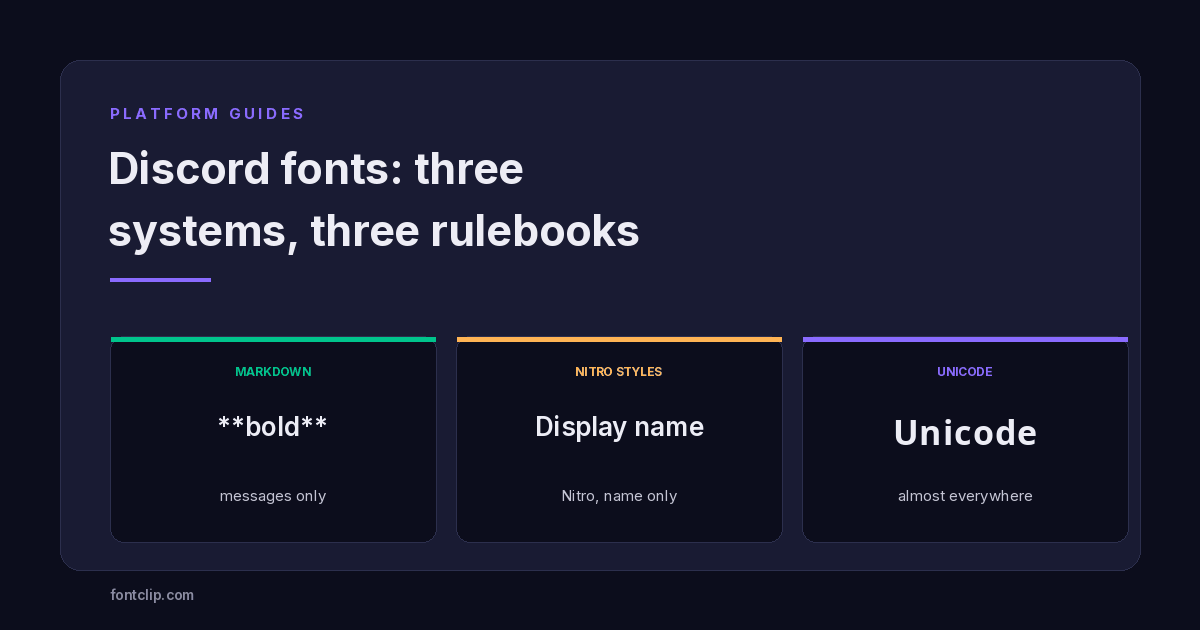
Discord has three separate systems for changing how text looks, and almost every guide online covers one of them while implying it covers all three.
That is why advice about Discord fonts and Discord text formatting so often fails. Someone reads that **bold** makes text bold, tries it in their bio, and nothing happens. Someone else pastes a styled name into their username field and gets rejected. Both followed correct instructions for the wrong system.
This guide covers all three, which fields each one reaches, and which styles survive being seen by other people.
The three systems
1. Markdown formatting
This is what Discord text formatting properly refers to — the built-in syntax: **bold**, *italic*, ~~strikethrough~~, ||spoiler||, backticks for code, and -# for subtext.
This is real formatting rather than character substitution, so it has no downsides — screen readers handle it normally, it costs no extra characters, and it cannot render as boxes. It works in message content only. Not bios, not names, not channel titles.
2. Display Name Styles
A Nitro feature Discord introduced in 2026, letting subscribers apply fonts, colours and effects to their display name from within Discord's own settings. Discord documents the options in its Display Name Styles FAQ.
This is genuine font rendering, not Unicode substitution. The underlying text stays plain, which means it stays searchable and readable to assistive technology. The limitations are that it requires Nitro, applies only to the display name, and Discord notes that some symbols fall back to the default typeface.
3. Unicode styled characters
What most people mean by Discord fonts: substituting letters for Unicode characters that look styled. No Nitro required, and it works in almost every field Discord has.
It also carries every cost covered elsewhere on this site — searchability, screen readers, and rendering gaps. It is the most flexible option and the most expensive one.
Which system reaches which field
This is the part that resolves most confusion. The three systems do not overlap much, and knowing which reaches where saves a great deal of trial and error.
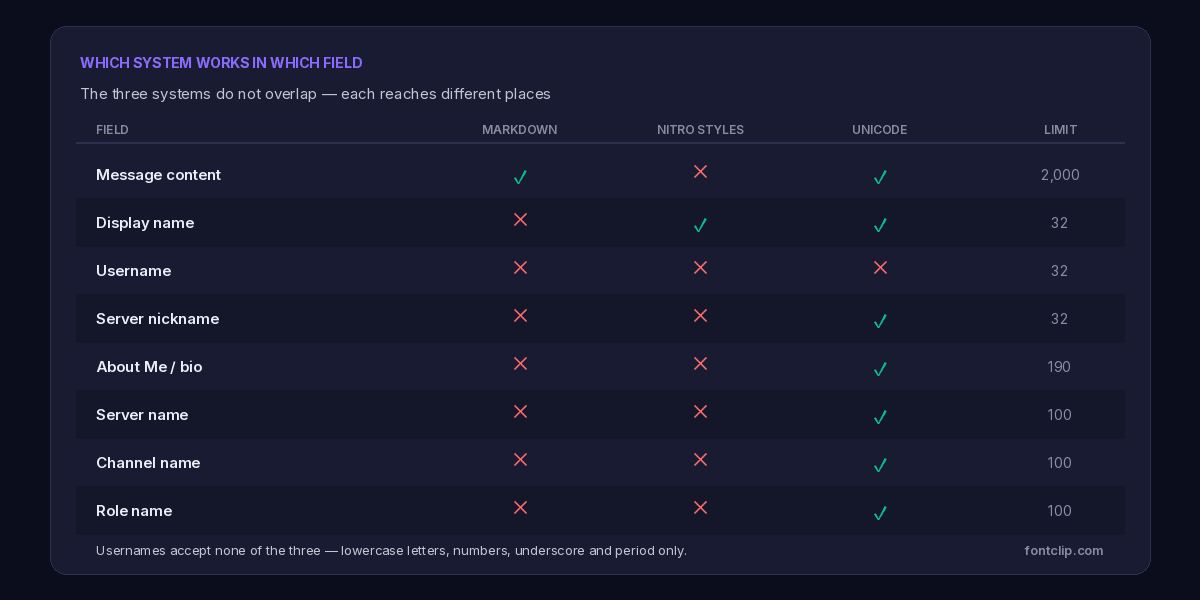
The username is the exception
Your Discord username — the unique lowercase handle, not the display name — accepts none of the three. It permits lowercase letters, numbers, underscore and full stop, and rejects everything else.
This trips people up constantly, because Discord has two name fields and they behave completely differently. The username is your permanent identifier and is deliberately restricted. The display name is what people actually see, and it accepts almost any Unicode character.
If a styled name is being rejected, you are almost certainly editing the username rather than the display name.
Server nicknames override everything
A nickname set inside a particular server replaces your display name in that server only, and it accepts Unicode the same way. Server administrators can restrict or reset nicknames, and some larger servers ban styled names outright for moderation reasons.
So if your styled name shows correctly in one server and plainly in another, that is a server rule rather than a rendering failure.
Which styles actually survive
A styled name that renders perfectly on your screen can appear as empty boxes to half the people who see it. This is the failure people notice last, because you never see it yourself.
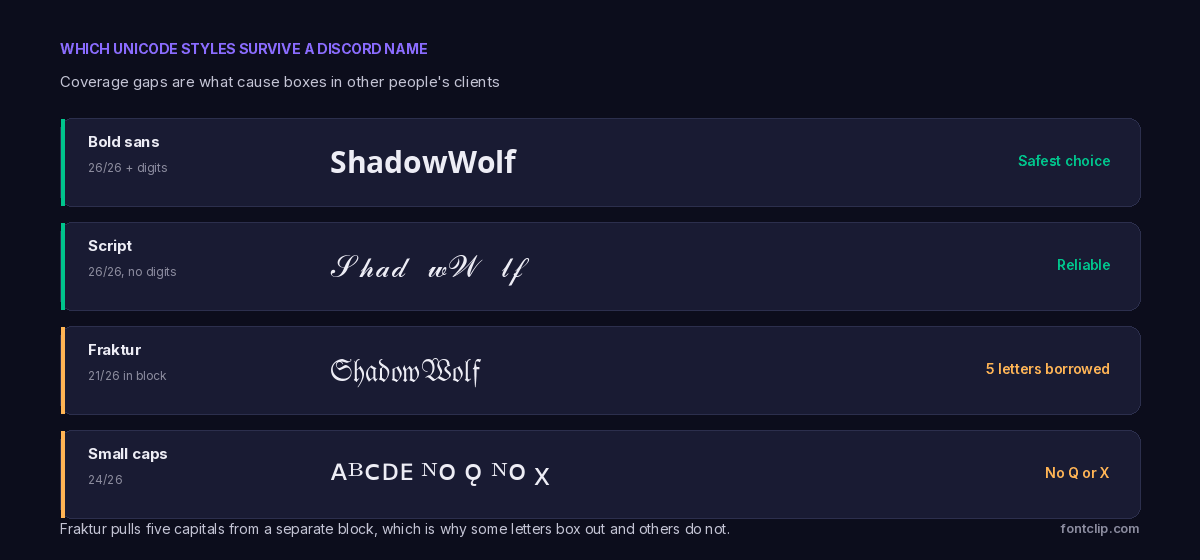
Bold sans is the safest
Complete coverage of capitals, lowercase and digits, and it comes from the most widely supported part of the mathematical alphanumeric range. If you want a styled name that will render for essentially everyone, this is it.
Fraktur is the riskiest common choice
Blackletter is popular on Discord and it has a structural problem. Five capitals — C, H, I, R and Z — are not in the fraktur block at all. They were encoded earlier in a separate block called Letterlike Symbols, so a fraktur word is quietly assembled from two different Unicode ranges.
When a device has font coverage for one range but not the other, you get a name that is partly boxes. This is why blackletter names so often look broken in a way that other styles do not — the failure is per-letter rather than all-or-nothing. Our blackletter guide covers the split in detail.
Small caps has two gaps
No small-capital Q or X exists in Unicode. Generators substitute plain letters, producing a name where one letter sits at a different height. Fine if your name avoids those letters, visibly inconsistent if not — the small text comparison has the full coverage tables.
Cursed and zalgo styles
Worth a specific warning for Discord. Combining-mark styles cost roughly six times plain text, and a display name is capped at 32 characters. That leaves about five visible letters. They also fail on older Android in a distinctive way, with marks scattering across neighbouring characters. Cursed text belongs in messages, not names.
The 32-character limit is really 16
Display names and nicknames are capped at 32 characters. That sounds generous until you style them.
Discord counts UTF-16 storage units, and the mathematical alphanumeric characters that produce bold, script and fraktur all sit above U+FFFF, costing two units each. A ten-letter styled name consumes twenty of your thirty-two.
The practical ceiling for a fully styled display name is about sixteen visible letters. Longer names get truncated, and truncation can sever a two-unit character in half and leave a broken symbol at the end.
Styles that do not cost double
Small caps, circled letters and fullwidth characters sit below U+FFFF and cost one unit each, the same as plain text. If you want a long styled name, these are the only options that fit. Fullwidth in particular is complete and well supported.
What Discord does not tell you about search
A cost worth understanding before committing to a styled name.
Discord's member search matches characters, not shapes. A styled display name is a string of different characters from the plain version, so someone typing your name normally will not match it. In a server with thousands of members, that means scrolling rather than searching.
Mentions behave differently and more usefully. When someone @mentions you, Discord uses your username — the restricted lowercase one — so mentions keep working regardless of how the display name is styled. This is the strongest argument for the two-name system: your identity stays typeable while your presentation stays free.
The pattern that works: keep the username plain and searchable, style the display name. You get the visual identity without becoming unfindable.
Server and channel names
Beyond personal names, Unicode is heavily used for server structure, and the considerations differ.
Channel names have a quirk worth knowing: Discord lowercases them and replaces spaces with hyphens. Unicode styled characters bypass this, because Discord's lowercasing does not map styled capitals to styled lowercase. That is why so many servers have channel names in styled capitals — it is the only way to keep capitals at all.
The trade-off is real though. Channel names are how members navigate a server. A channel list entirely in decorative Unicode is harder to scan, and search within Discord will not match a styled channel name against a plain query.
The pattern most large servers settle on is a decorative divider between plain-named channels — the structure stays scannable while the server still looks designed.
Practical recommendations
Messages
Use markdown. It has no downsides, works for everyone, and costs nothing. Reach for Unicode only when markdown cannot do what you want.
Display name
Bold sans or script, under sixteen letters. If you have Nitro, the official Display Name Styles avoid the searchability cost entirely.
Username
Leave it plain. It cannot be styled, and it is what mentions and search rely on.
Server design
Decorative dividers between plain channel names. Keep the names people need to find readable.
Testing before you commit
You cannot see rendering failures on your own device, because your device has the fonts. A short check is worth the effort for anything permanent.
- Send it in a message first and view it on your phone as well as desktop. Different platforms, different font stacks.
- Ask someone on Android to confirm it renders. Android font coverage varies most between devices.
- Check the length after saving. If the last character looks wrong, it was truncated mid-character.
- Try mentioning yourself to confirm the username still works normally.
Why Discord became the centre of this
Styled Unicode text is used across every platform, but Discord is where the practice is most developed, and there are structural reasons for that.
Discord gives you more text fields than any comparable platform. A display name, a per-server nickname, a bio, a custom status, server names, channel names, category names, role names. Most platforms give you a username and a bio.
It also has a visible member list. On Instagram your name appears when someone visits your profile; on Discord it sits in a sidebar next to everyone else's, permanently, in every server you share. The incentive to stand out is structural.
And Discord servers are designed spaces. Someone builds the channel structure, picks the categories, assigns role colours. Text styling is part of that design work in a way it simply is not on a feed-based platform.
The introduction of official Display Name Styles is Discord acknowledging this. Users were reaching for Unicode workarounds so consistently that building a real feature became worthwhile — one that achieves the same visual result without breaking search or accessibility.
The short version
- Three systems exist: markdown (messages only), Nitro Display Name Styles (display name only), and Unicode (nearly everywhere).
- The username accepts none of them — lowercase letters, numbers, underscore and period only.
- Display names and nicknames cap at 32 characters, which is about 16 styled letters because most styles cost two units each.
- Bold sans is the safest style. Fraktur is the riskiest: five capitals live in a separate block, so names render partly as boxes.
- Small caps, circled and fullwidth cost one unit each, so they fit far more text into the same limit.
- Styled names are not searchable, but @mentions use the plain username and keep working.
- Server admins can restrict nicknames, so a name that works in one server may not in another.
Every one of these Discord fonts is on the Discord font generator, which flags the ones with coverage gaps rather than presenting them as equivalent. For the underlying reason styles break on some devices, see why fancy text shows as boxes.
Related Articles
 Style Guides
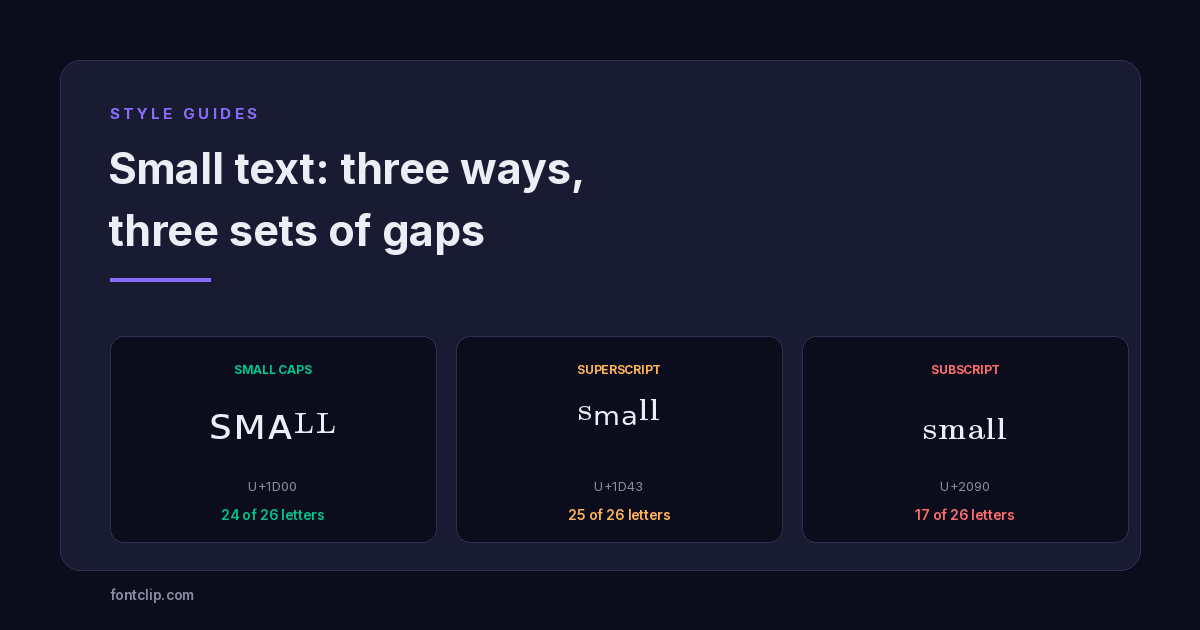
Small Text: Small Caps vs Superscript vs Subscript
Three Unicode small-text styles, and the letters each one is missing. Small caps has no Q or X. Subscript is missing nine.
Read article →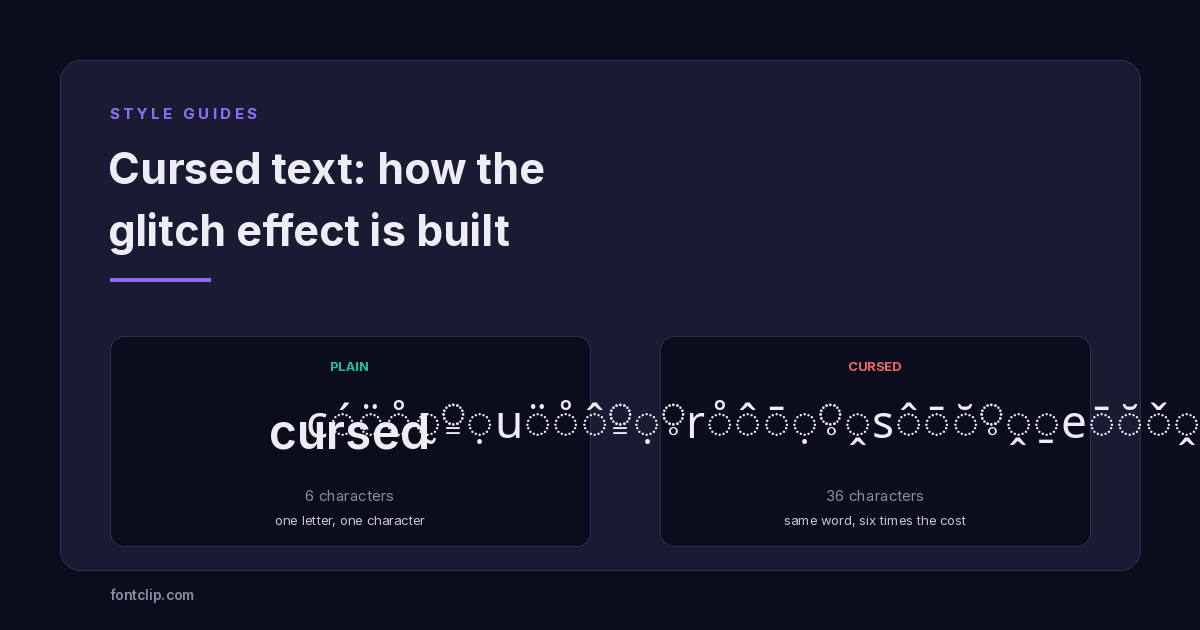 Style Guides
Cursed Text: How the Glitch Effect Is Actually Built
It stacks marks on your letters instead of replacing them. Why that costs six times plain text and breaks in every bio field.
Read article →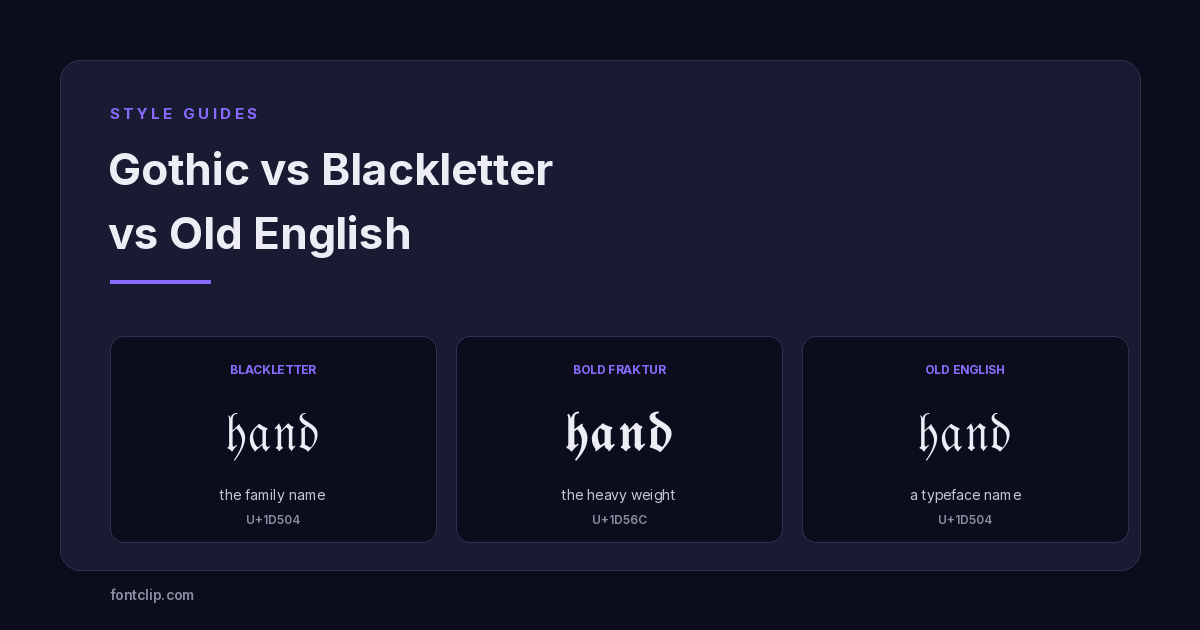 Style Guides
Gothic vs Blackletter vs Old English: A Typography Primer
Blackletter is the family, Fraktur is one branch, Old English is a typeface name. What each term means, and the two alphabets Unicode actually ships.
Read article →Put It Into Practice
285 named, tested styles — with an honest note wherever one has limits.
Open the generator →